5 Star Residential and Commercial Roofing
Commercial Roof Leak Repair in Amarillo, TX

Quick Summary
- •What this page covers: one job, finding and stopping an active water leak on a commercial building in Amarillo. Not a roof replacement page and not a services overview.
- •The hard part is the diagnosis, not the patch. On a low-slope roof the entry point is rarely above the ceiling stain.
- •Two separate steps: temporary dry-in to protect what is under the roof today, then a permanent repair scoped from what the survey actually found.
- •Next step: call (806) 622-6041 for a leak assessment, or use the contact form on this page.
Water Is Coming In. Here Is What Actually Happens Next.
This page is about one specific problem: your Amarillo building has water coming through the ceiling, down a wall, or pooling on a stock room floor, and you need it stopped. Choosing a roofing system or planning a replacement is a different page. If a leak is running right now, the sequence that matters is find it, dry the building in, then fix it properly, in that order, with those three treated as separate pieces of work rather than blurred into one vague quote.
The call almost always sounds the same. The leak started during a storm, somebody put a trash can under it, and now it is back. The building owner wants to know two things: can you make it stop, and is this a patch or the beginning of a much bigger conversation. Both are answerable, but only after somebody has been on the roof.
Why the Leak Is Almost Never Directly Above the Stain
On a steep residential roof, water runs downhill and gravity does most of the detective work for you. A commercial low-slope roof behaves nothing like that. Water that gets through the membrane lands on insulation, runs along the joints between boards, tracks sideways across a steel or wood deck, follows a purlin or a joist for twenty or thirty feet, and finally drips through the first available opening: a fastener hole, a light fixture penetration, a deck seam. The stain marks the exit, not the entry.
This is why cutting a patch above the drip so often fails. The patch goes on a perfectly sound piece of membrane, the owner pays for it, and the next storm produces the same wet ceiling tile. It is also why a proper leak call takes longer than people expect on the first visit and less time than they expect on every visit after. Finding the entry point once, correctly, is what ends the cycle.
Where Amarillo Commercial Roofs Actually Let Water In
Membrane fails in the middle of a wide open field far less often than owners assume. Nearly every leak we chase in the Panhandle starts at a detail, somewhere the roof had to be interrupted, terminated or attached.
Curbs, pipes and rooftop equipment
Every HVAC curb, vent, conduit and pipe boot is a hole somebody sealed. Sealant ages, boots split, and units get serviced by technicians who walk and kneel on flashing that was never designed for it. On a busy commercial rooftop this is the single most common source we find.
Seams, laps and field splices
Single-ply membrane is watertight in the sheet and vulnerable at the join. A seam that was cold-welded, contaminated with dust during installation, or stressed by thermal movement will open before the membrane itself does. Amarillo's temperature swing works those joins hard every single day of the year.
Drains, scuppers and standing water
A blocked drain turns a low spot into a pond, and a pond finds every weakness the roof has. Clamping rings loosen, drain bowls corrode, and debris from Panhandle wind collects exactly where you cannot see it from the ground. Ponding does not cause the leak so much as it guarantees you find one.
Parapet walls and terminations
Where the roof stops and turns up a wall, it depends on counter-flashing, coping and a termination bar to stay sealed. Wind-driven rain gets behind failing coping joints and enters the building without ever touching the roof field. Owners often spend months looking at the wrong surface.
Hail bruising that opened later
Potter County has recorded 131 severe hail days since 2000 and Amarillo averages 8 to 12 hailstorms a year. Hail frequently bruises a membrane without breaking it. The impact crushes the material against the substrate, the reinforcement is weakened, and the actual opening appears a season or two later, long after anyone connected it to the storm.
Fasteners working back out
Amarillo sits at 3,600 feet with an annual average wind of 14.3 mph and spring gusts well beyond it. Constant uplift flutter backs fasteners out of the deck over time. The plate telegraphs through the membrane, wears a hole from underneath, and the leak arrives with no visible damage on top at all.
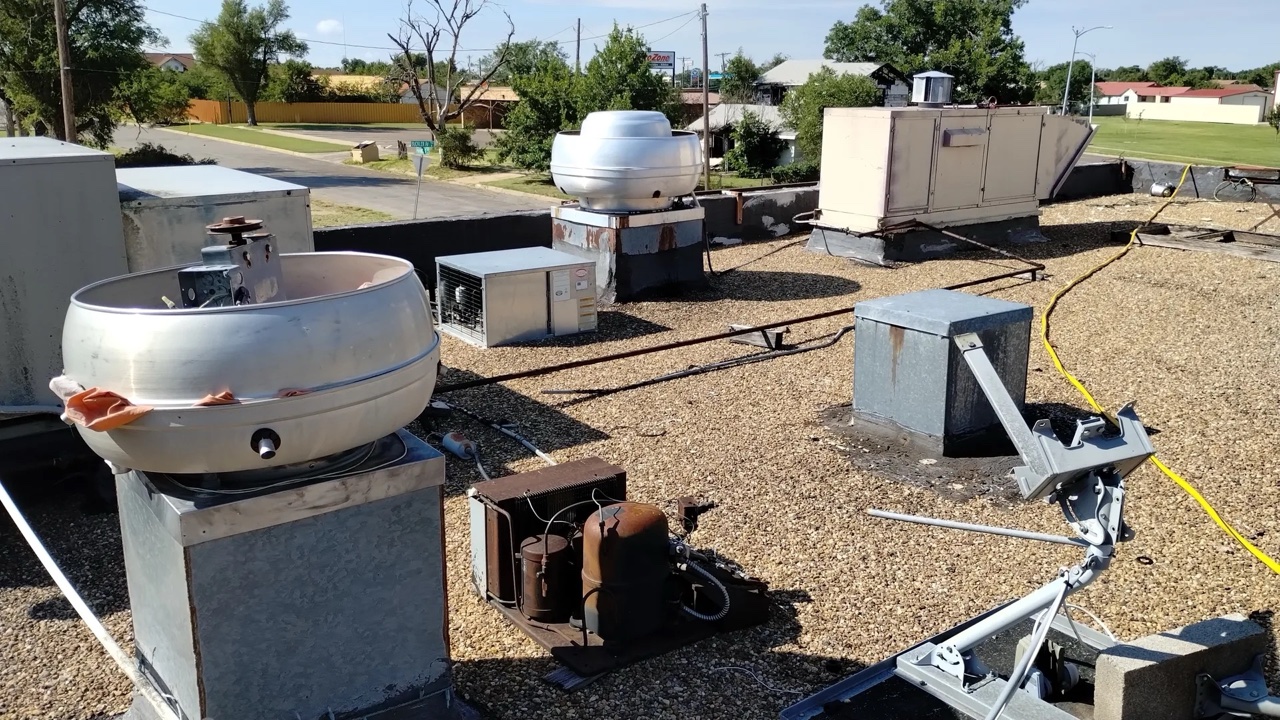
A rooftop like this one is mostly details. Count the curbs, the supports, the conduit runs and the vents in a single photograph and you have counted the realistic suspect list. Open field membrane is the easy part of a commercial roof; everything that interrupts it is where the work is.
How We Find It
The sequence matters, because each step narrows the search area for the next one. Skipping straight to the roof and hoping something looks obviously wrong is how people end up patching sound membrane.
1. Map it from inside
We start under the roof, not on it. Where is the water appearing, how many places, which direction does the deck run, and does it only leak in a driving rain from one direction? That last question alone often moves the search from the roof field to a parapet or wall.
2. Walk and photograph
A full walk of the roof surface with photographs of every penetration, seam, drain, curb and termination, not just the area above the stain. You get those photos whether or not you hire us, and they become the baseline for anything we do later.
3. Survey for moisture
An infrared or capacitance survey maps where water is already sitting inside the assembly. This is the step that separates a contained repair from a large one, because saturated insulation has to be cut out and replaced before anything is sealed back over it.
4. Test and confirm
Where the evidence still points at two or three candidates, we flood one suspect area at a time with somebody watching from below. It is slow and it is unglamorous, and it is the only way to be certain before you spend money on a repair.
A core cut usually goes in at the same visit. It tells us what system is up there, how many layers the building already carries, and what condition the deck is in, which between them decide whether a repair is even the right answer.
Leaking Right Now? Dry-In Comes First.
Temporary dry-in and permanent repair are two different jobs and we price them that way. If water is running into your building, the first priority is getting it stopped: sealing the opening, patching the membrane, or covering the area with weatherproof sheeting so your inventory, equipment and operations are protected while the real scope gets worked out. What we will not do is present a temporary patch as a finished repair and hand you an invoice.
Call (806) 622-6041When a Leak Is a Repair, and When It Is Telling You Something Else
Most leaks are repairs. One failed boot, one open lap, one corroded drain on a membrane that is otherwise doing its job is a contained piece of work, and treating it as anything more than that is how contractors get a reputation in a town this size.
Points to a repair
- One leak, one location, one storm direction
- Moisture survey shows an isolated wet area
- Membrane still flexible and well adhered
- Deck sound and holding fasteners
- Roof still inside its expected service life
Points to a bigger conversation
- Several unrelated leaks in the same season
- Widespread saturation on the survey
- Membrane brittle, chalked or shrinking at edges
- Seams failing in more than one area
- Deteriorated deck under the wet zones
If your roof is landing in the right-hand column, spending money on a third patch is spending money twice. Our commercial flat roof systems page covers what the alternatives look like (membrane replacement, recover, coatings and full tear-off) and is the right place to start once repair has been ruled out. This page stays on the narrower question of stopping a leak on the roof you have.
What Actually Drives the Cost of a Leak Repair
We will not put a number on this page, because a leak repair priced without seeing the roof is a guess dressed up as a quote. What we can tell you is what moves the figure, so you know what the estimator is looking at when the price comes back.
What keeps it small
- You called during the first season it leaked
- A single identifiable entry point
- Insulation below is still dry
- Materials on the roof are still available
- Normal working-hours access to the roof
What grows it
- Wet insulation that has to be cut out
- Deck repair once the wet material is off
- Multiple entry points in different details
- Obsolete membrane needing a transition detail
- After-hours work over occupied tenant space
The single biggest variable on that list is time. A leak that has been running for two springs has moved water a long way inside the assembly, and none of it dries out on its own under a membrane. The repair you postpone is not the repair you eventually buy.
If the Leak Started With a Storm, the Clock Is Already Running
Amarillo sits at the center of Hail Alley, where dry desert air meets Gulf moisture, and Potter County ranks in the top ten nationally for hail frequency. The largest stone on record here is 4.25 inches, softball size, from May 2019. A lot of the leaks we get called to in June and July started as impacts nobody documented in April.
If a storm is in the picture, Texas law sets the timeline rather than the carrier. Under the Texas Prompt Payment Act an insurer must acknowledge your claim within 15 days and pay or deny within 60 days, delayed payments accrue 18% annual interest, and you have a two-year window from the date of loss to file. We document the roof and meet the adjuster on site so the approved scope reflects the actual condition of the assembly, including wet insulation, which is the part that most often gets left out of a scope written from the ground.
Where We Work
We run leak calls out of 2909 S Western St in Amarillo and across the surrounding Panhandle and West Texas market, including Canyon, Borger, Pampa, Dumas, Hereford, Bushland, Plainview, Dalhart, Perryton, Tulia, Friona, Childress, Levelland, Lubbock, Midland and Odessa.
Frequently Asked Questions
Visit Our Amarillo Location
Commercial Roofing in Nearby Cities
We also provide expert commercial roofing services in these nearby communities:
Other Roofing Services in Amarillo
Looking for other roofing services? We offer comprehensive roofing solutions in Amarillo:
Find the Leak, Not Just the Stain
Leak assessment with a full roof walk, photographs and a moisture survey. The photos and the findings are yours whether you hire us or not.